What is Rethink Sustainability?
Welcome to Rethink Sustainability! This campaign is officially launching on the 18th January. The core aim of this work is to bring you transparency, information and resources on the full narrative of sustainability. There are lots of opportunities to get involved, develop your understanding and make change so make sure to come back and see for yourself after we launch.
This campaign is not an exhaustive list, it will be vital to reflect and expand this work to support students to have the voice and the agency to make real change. The climate crisis requires urgent action now and universities have a responsibility to commit meaningfully to ensuring a sustainable and ethical future for all members of their community.
You can register your interest for the campaign here and share your feedback and suggestions as well.
Best wishes,
Elle
Your Activities Officer 2020/21
How can you get involved in Sustainability?
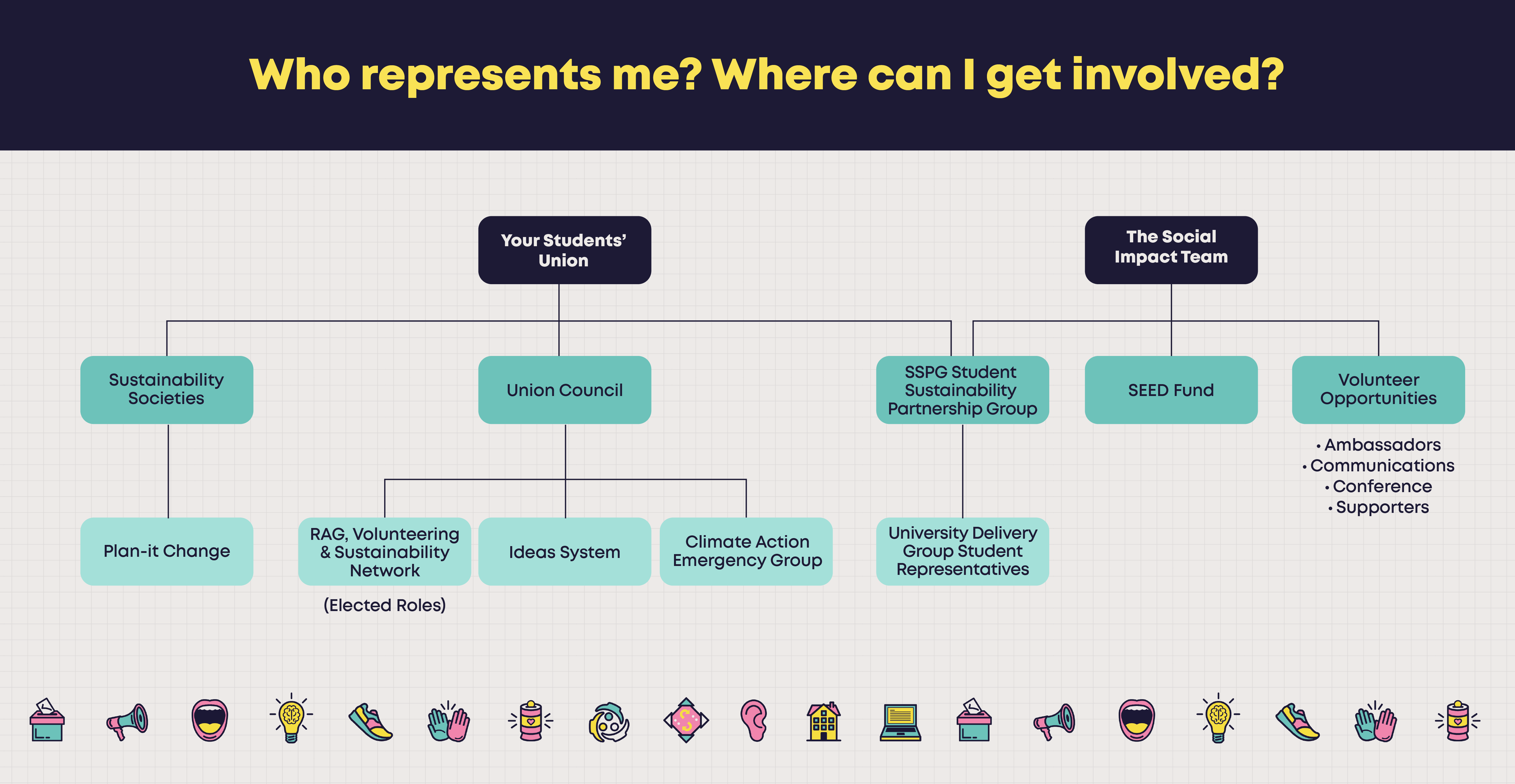
If you are interested in getting involved in any of the groups mentioned above, please email our Activities Team.
Key Sections
As part of this campaign, we will be shedding a light on a wide range of topics and issues. Please see below a list of the areas we will be covering - if the page is not live yet, it will be soon so keep a look out.
1. Investment and Ethical Investment Policy
Students Organising for Sustainability’s (SOS) Invest for Change campaign explains more about the role of investments and the impact they can have on climate justice and the planet.
Why is this important?
- UK universities have over £15 billion of investments, often invested in corporate companies doing little or no public good. We’ve all heard about the companies extracting fossil fuels, violating workers' rights, manufacturing arms, avoiding tax or causing deforestation.
- In other words driving the climate crisis and social injustice. Imagine what would happen if this money was invested into companies and projects with real-world impact: those building renewable energy infrastructure, supporting communities or developing social housing.
- You have the power to change this. Students are key stakeholders in university decisions and universities, as progressive public bodies, should be making decisions that lead the way towards a sustainable and resilient society.
- Melanie Kee, Campaign Manager SOS Invest for Change
What is Divestment and how is it linked to Decolonisation?
‘Divestment is an incredibly important means through which the University can help assist the fight, both against the climate crisis and structural racism, which go hand in hand. The biggest corporate polluters often exploit cheap labour in the global south and the direct result of their carbon emissions are seen in the increasing numbers of natural disasters occurring in lands outside of ‘the west’. Part of the University’s commitment to addressing these issues must ensure a policy of non-complicity with these practices, and therefore divest from firms and companies which are guilty of worsening the climate crisis and partaking in structural oppression. This also goes hand in hand with efforts from students & academics across the globe to decolonise our systems of education, so that the success of institutions here are not founded on the back of oppression and natural disasters in the global south.’
– Adnan Rahman, Education Officer 2020/21
What’s the situation at the University of Leicester?
The University of Leicester’s Ethical Investment Policy outlines the following commitments;
The University will not invest directly in those organisations where the primary part of their business is:
· the manufacture and sale of armaments to military regimes.
· the manufacture and sale of tobacco products.
As of January 2020, the University committed to not investing directly in the production and sale of fossil fuels.
In assessing investments and selecting underlying fund managers the University seeks to avoid businesses that demonstrate the following characteristics:
- explicit environmental damage
- institutional violations of human rights, including the exploitation of the work force
- discrimination against the individual
The University commits to investing 11% of its endowment funds into ‘Impact’ projects, “The impact investing portfolio is diversified across eight themes and investment areas, five of which are focused on climate: sustainable agriculture, sustainable transport, waste & materials, ecosystem services and clean energy.” However, as of yet there is not transparent information on which projects are being funded and prioritised in these areas.
For full publicly available policy, you can click here, or find out more about climate change and divestment at University of Leicester.
The Investment Managers at University of Leicester?

Transparency and Representation?
People & Planet league ranked the University the following score based on this:
0/15% for including the following specifics within the policy;
-including student representation on their investment committee
-publicly listing their investments annually
View the full rankings here.
2. Climate Justice Campaign
3. University Sustainability
4. Climate Anxiety and resources
More sections will be added soon.
Want to learn more?
Express your interest
Interested in getting involved with the campaign? Whether it's sharing your ideas or wanting to be kept in the loop with updates related to Sustainability.
Sustainability Podcasts
Liberating sustainability podcast
Liberating Sustainability, produced and presented by Jelena Sofronijevic and Hatty Ruddick, is an intersectional take on the climate emergency. Over five weekly episodes, the podcast focuses on the intersections of race, sexuality, class, gender, and ability. In each episode, field leaders from student liberation movements and academia deconstruct the exclusivity of sustainability activism and education.
If you'd like to find out more about the creators of the podcast, click here!
Who can I follow on Twitter?
More information coming soon!